
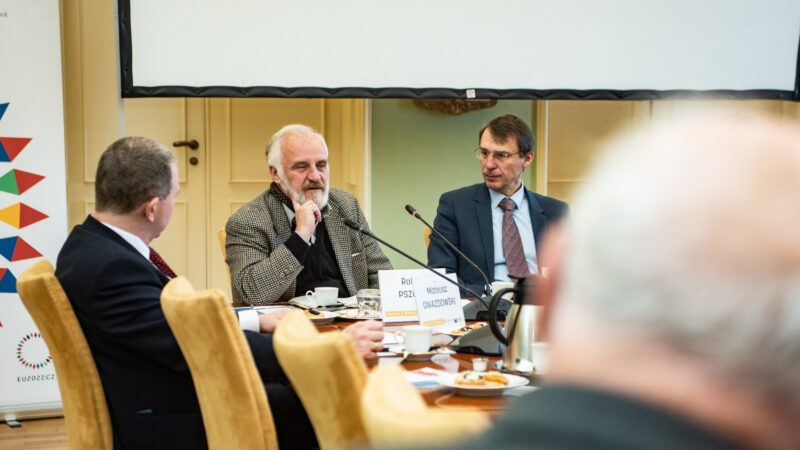
There is a concern that having escaped from Russian embrace, Germany may fall into the arms of China. You ought not to make the same mistake twice, Robert Pszczel told EURACTIV.pl in an interview.
Robert Pszczel is a security policy expert and a former head of NATO Information Office in Moscow.
Has the war in Ukraine exposed the role of the United States as the leader of the free world?
The United States has proven to be a key actor in mobilising the international community for a proper and united response to the Russian aggression in Ukraine. The US is also the undisputed leader when it comes to helping Ukraine. Washington also took on the role of coordinating military support, which NATO could not undertake – because it does not possess equipment, among other reasons.
In addition, the Americans are fulfilling their promises in terms of additional strengthening of the security of NATO front-line states. If you look at the U.S. military presence, all kinds of efforts to improve security, they are concrete, no empty slogans.
There is no doubt that the United States is showing the kind of leadership that everyone expects. And let’s not forget that Americans generally like to support those who are successful. And since Ukraine is successful in the war against Russia, Washington is even more willing to support Kyiv.
How would you assess the attitude of NATO headquarters in the face of the war in Ukraine? NATO as such has limited powers, but it tries not to irritate Russia, and the issue of Ukraine’s accession to the Alliance has been stalled for years.
It is true that NATO is trying to avoid a direct armed confrontation with the Russian Federation. NATO’s policy, however, depends on what is possible in terms of what member states are willing to agree to.
It is not that NATO has only started to help Ukraine after February 24. The alliance had already supported Ukraine in the area of defence reform, reaching the Alliance’s standards in various fields and training, for example in cyber defense. NATO, through its agencies, can also help negotiate better terms for Ukraine’s arms purchases.
NATO chief Jens Stoltenberg says the goal is to support Ukraine to the extent it needs to win the war – an approach that has become the NATO official policy. As for membership, at the 2008 Bucharest summit the Allies confirmed the will of Ukraine to join NATO in the future, but further steps in this regard are blocked by individual countries. It is essential to work towards this approach to change.
Meanwhile, the role of China is growing, which, moreover, is strengthening cooperation with Russia. Should we expect Beijing’s direct involvement in the Russian war against Ukraine?
The Chinese are trying to take on debt. Over this war, they support the Russian veto in the UN Security Council on various issues. China is taking advantage of the fact that today it is more difficult for Russia to sell raw materials and therefore Beijing can negotiate better prices.
Yet, unlike Russia, China is not a country that seeks to destroy the entire international system, because it benefits greatly from international trade. Even if China did not join the anti-Russian sanctions, Chinese companies are very cautious about investing in Russia, as they do not want to be subject to sanctions.
China has not directly provided military support to Russia, which the Kremlin has been seeking for a long time. Today, it does not look like that China is ready to take Russia’s side in this conflict.
The role of countries such as India and Turkey is also growing. For instance, Turkey is blocking the NATO accession of Finland and Sweden, trying to play as much as possible on it.
As far as India is concerned, the country’s attitude towards Russian aggression in Ukraine will not serve its reputation or interests in the long run. India is currently focused on simple and interim benefits, such as lower Russian oil prices. Therefore it does not want to join the sanctions. However, India is in a dispute with China, so it will look for allies, and India’s natural ally is the Western world.
India was a country that had good reason to believe that if the UN Security Council system was reformed, it could become a new permanent member of this body. So they cannot act unethically, sowing doubts about who is the aggressor and who is the victim in the war in Ukraine. If India supports politically the aggressor state because of its misplaced neutrality, the chances of anyone supporting India’s ambitions for permanent membership of the Security Council drop to minimum.
In turn, Turkey actively supports Ukraine, including by the enforcement of the agreement on grain exports or support for the supply of Bayraktars, as well as a tough stance on the sovereignty of Ukraine and the status of Crimea.
On the other hand, Ankara is playing a game that is not entirely in line with NATO, for example by blocking the admission of Finland and Sweden to NATO. This type of action is harmful to the Alliance, also from the point of view of the security of front-line states, such as Poland, since the NATO membership of Sweden and Finland will improve the security of the entire alliance, and especially the eastern flank. Also, it is hard to accept Ankara’s last threats towards another NATO country, Greece.
Turkey is a very helpful and constructive country on Ukraine. However, the same cannot be said for other areas of its activity.
French President Emmanuel Macron, who has so far advocated a policy of strategic autonomy for the EU, is changing his approach. During a recent visit to the US he advocated what he himself called the concept of „strategic intimacy“, which – according to his words – means strengthening cooperation with Washington. What can that mean?
I am not a supporter of Macron’s concept of European strategic autonomy on defence, understood as doubling the NATO system. This is not only a wrong, but a very dangerous concept that results from open or hidden anti-American tendencies in Western European countries or at least the lack of trust towards the US as an ally. The anti-US sentiment was also one of the reasons why for many years Sweden was not ready to apply for NATO membership.
However, set aside political sentiments, in a tough security environment, there is currently no way to replace the role of the United States, especially from the point of view of NATO’s eastern flank. In this respect, things look as they do.
Macron uses political neologisms, but what does „strategic intimacy“ exactly mean? The French president did not explain this term too explicitly. In its last interviews he rather reinforced the doubts than resolved them.
If „strategic intimacy“ means closer cooperation with the United States, this is good news. But at the same time, it is primarily Paris that opposes the US economic policy and even suggest going towards economic dispute. This would not help the trans-atlantic unity.
However, in the face of the war in Ukraine it was the United States that emerged as the real leader of NATO, which cannot be said about Germany or France.
Yet, there are still doubts about Paris’s approach to Russia. The statement on the need to discuss security guarantees for Moscow is a misunderstanding, and, moreover, is incompatible with the agreements within NATO. The same can be said of obsessive desire to call Putin. There must always be a formal or legal basis for one European country to act on behalf of other countries in relations with third countries. In this situation, there are no such grounds, and therefore it is hard to accept that France acts on behalf of the whole of Europe in talks with Russia.
Criticising the approach of France in various field, it is nevertheless crucial to remember that France is our (Poland’s) ally and key European partner, with a considerable potential. France must be paid tribute for being the first country in Europe to talk about the need to shift the defense industries to war mode. It was the first major European country to reform its armed forces for a possible use in a major conflict.
You mentioned Germany. German Chancellor Olaf Scholz in his last article outlines the assumptions of the „Zeitenwende“ concept and states that Germany should become the bridge-builder within the European Union and the guarantor of European security.
Scholz writes about how he would like his politics to be seen. Still, this does not mean that other countries must see it exactly that way. The problem lies in the discrepancy between the declared goals and the possibility of their implementation. Today, it’s not serious anymore to think that someone longingly expects Germany to be a guarantor of the security of other European countries.
On the other hand, we would like Germany to deliver its obligations within NATO, starting with spending at least 2 per cent of its GDP on defense.
If we return to the speeches by German foreign and defence ministers from the 1970s, or 1980s we realise that they sound very similar to what we hear today from the Baltic states: the expectation that the allies will spend more on defense or send more troops to the NATO eastern flank. All this was an immanent and integral part of German politics as long as Germany was a front-line state.
Today, Germany faces a charge of hypocrisy by those who remind them their own demanding a security umbrella from the NATO states, especially the United States. And if it were not for this support, we do not know how things would have turned out and whether there would have been a unification of Germany.
There are commitments within NATO and they need to be met. Germany must show maximum solidarity and understanding with regard to the needs and interests of other countries, which are much more vulnerable, especially to the Russian threat. Meanwhile, Berlin has shown short-sightedness and for a long time was misjudging the security situation.
It is about understanding your own mistakes, which is a key thing to change one’s approach. Sadly, former Chancellor Angela Merkel still has not admit that her policies were wrong.
President Frank-Walter Steinmeier admitted Berlin was wrong, but the steps that Germany is taking to change its policy, such as reinforcing its support for Ukraine and replacing Russian gas, are still not enough and are not entirely convincing. Moreover, not all German lands share the federal government’s position on the revision of policy towards Russia. In Mecklenburg, for example, there is still very strong resistance to cutting the strategic economic ties with Russia.
There is also a concern that having escaped from Russian embrace, Germany may fall into the arms of China. One of the issues that raise such fears is the sale of a part of the Port of Hamburg to a Chinese company. Also, Germany cannot accept a situation in which they are not able to produce significant components of their defense system because of their dependence on Beijing. You should not make the same mistake twice.
How can Poland strengthen its voice on the world stage, so that it becomes a crucial actor in geopolitical discussions of the world’s key powers?
Poland should focus on these elements of its policy and highlight those of its achievements in which it poses a good example for others, for example, in terms of defense spending or support for Ukraine. In these matters, Poland is a worthy example and enjoys international respect.
The reaction of the government in Warsaw after the explosion of a rocket in the pipeline was met with great recognition. There was no panic nor pressure on the whole North Atlantic Alliance to take certain decisions.
However, in order for Polish policy to be reliable, we need the right people who will implement it. Thie personnel cleansing that took place in the Foreign Ministry and other key ministries did not help. Today, Polish diplomacy lacks experienced diplomats who cannot be replaced so easily with the young personnel.
Moreover, while in some cases Poland poses a good example for other countries, in others it is rather presented as a bad example. It is mainly about various disputes with the European Union. Those disputes also weaken Poland’s foreign policy.
In addition, Poland ought to further strengthen its cooperation with other countries, especially the regional partners. It would be good to see more joint initiatives. Why can’t Poland become one of the leading countries to present a new Marshall plan for Ukraine? The same can be said about more specific security guarantees ideas for Kyiv.
We are at a turning point for relations in Europe. The ongoing war has changed a lot in the architecture of European defense, but also in the policies. Nothing will be the same. In the new order, the role of Poland and other countries in the region must increase. We cannot accept someone else to decide matters that are critical to our security. We remember what the monopolising of the debate within the Normandy Format by Germany and France resulted in.
We need to have more to say about our policy towards Russia than France or Germany. But to achieve this, we need arguments. We need to fight for our position in the diplomatic field – both in European capitals and in Washington.