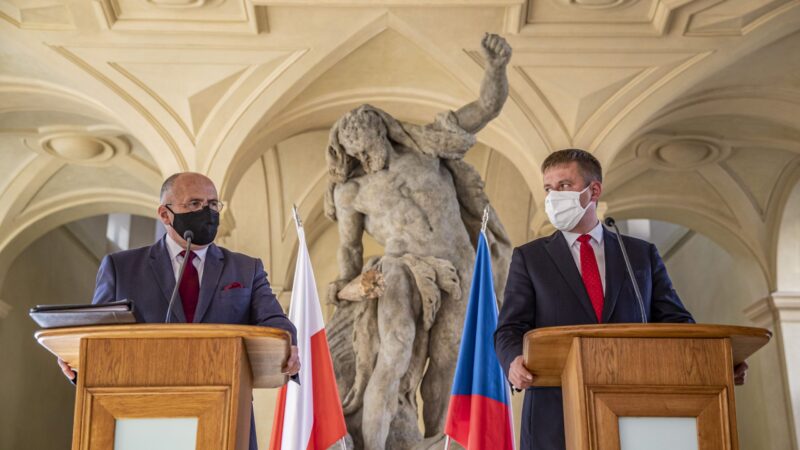
The Czech Republic and Poland cooperate at political as well as economic level on bilateral and multilateral fora. What are areas of agreement and of disagreement?Common market with four freedoms, digitalisation, common agriculture and cohesion policy, EU enlargement toward Western Balkan, Eastern partnership or security policy are areas of common interest for the Czech Republic and Poland. Their representatives discussed them during the debate which was organised by Spolek pro evropskou politiku, with support of the Ministry of Foreign Affairs of the Czech Republic within the Czech Polish Forum, and Hanns-Seidel-Stiftung Prague Office.“Czechia and Poland are close partners, not only politically but also economically,” said Polish Foreign Minister Zbigniew Rau. Czechia is, among others, the second largest market for Polish products and the second largest receiver of Polish investments in the world. According to his Czech counterpart Tomáš Petříček, Czechia and Poland can also cooperate in tackling common challenges like carbon-neutral economy, development of new technologies or cyber security.Bilateral and multilateral neighborhood relations
Both countries, together with Slovakia and Hungary, form Visegrad four (V4), a platform for regional cooperation. According to Vít Dostál, director of the Association for International Affairs Research Centre, the V4 could establish promising relationships not only within this platform members but also with other regional groupings such as Benelux, Nordic and Baltic States.Dostál also considers the joint meetings among Czech and Polish ministers of foreign affairs and defence, or their deputy ministers, as a good step in development of common relations mainly in defence and security policy. The format is called “2+2” and is similar to the one used before the both countries joined NATO.As stated above, the cooperation is not only at the political level but also at the economic level. Lukáš Martin from Czech Confederation of Industry (SP CR) explained that Czech and Polish companies collaborate in the area of both digital services and technologies as well as circular economy.In his view, Poland must play a key role in strengthening transatlantic ties. The SP CR shares this attitude with its Polish partner, Business Confederation Lewiatan.Sensitive issues
Migration is a thorny issue for both countries. “The V4 criticises the relocation system from the very beginning. They want to replace it with other forms of solidarity, such as support for countries of origin and protection of their borders,” Jolanta Szymańska from the Polish institute of international relations (PISM) reminded. Therefore, the new pact on migration and asylum, which the European Commission introduced in September 2020, satisfies the interests of Visegrad only partially.“The response of the V4 was very cautious, the countries are afraid of the mandatory relocation mechanism that could be triggered during the crisis,” Szymańska added.“Migration policy must be based on balance between solidarity and responsibility. It’s necessary to strengthen the protection of external borders, cooperate both within the EU and with third countries and prevent secondary movements of migrants across the EU member states,” minister Rau specified.Dostál also noted that Czechia and Poland share experiences with Chinese influence but in different ways. The Czech policy paper of AMO researchers identified, for instance, that Chinese companies have more friendly relations with Polish central, regional and local levels than in the case of Czechia. Deeper transatlantic relations of Poland with the US plays its role as well.Areas of disagreement
Poland and Czechia do not always find common ground. “I believe that there are many more areas where we agree than disagree, but there are of course natural differences in our approach in some policy areas. They mostly concern however more detailed elements within these policies“, said Minister Rau.One of the areas where both countries have a similar approach, but differ in details is the climate policy.“As opposed to Czechia, Poland does not have any nuclear power plants. We are more dependent on coal,” Rau acknowledged.Currently, both countries disagree on linking the EU’s future multiannual budgetto the rule-of-law conditionality.“Poland, just like the Czech Republic, supports reaching the agreement on the budgetary package as soon as possible, in order to start implementation of programs both from the regular Multiannual Financial Framework and the extraordinary Next Generation EU fund.” Polish Minister pointed out adding that Poland supports a package approach. It means that everything related to the budget and the recovery fund must be approved as a whole. However, part of the budget-package is the rule-of-law conditionality that was vetoed by Poland and Hungary.“The reason is that the legal basis of the mechanism is contrary to the EU treaties. There is also risk that the mechanism would be misused for politically motivated purposes because some of its provisions are not clearly defined,” Rau explained.The creation of a national recovery plans which are necessary in order to use funds from the EU recovery package, is also not discussed between both countries in detail. “The Czech Republic is rather in contact with countries that are in similar situations when it comes to coronavirus pandemic, such as Slovakia or France,” Czech Minister Petříček said. Nevertheless, both countries have to meet EU commitments. For instance, 20 % of the funds must go to digitalisation, 37 % for green transition.